

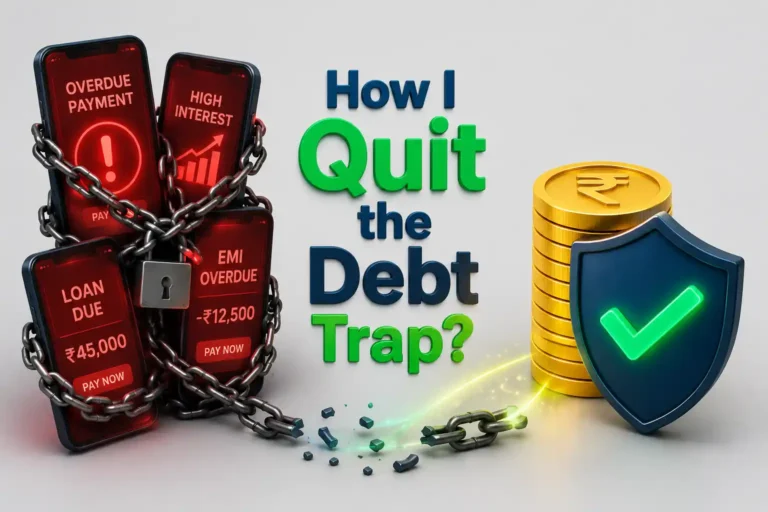
By early February 2026, I was suffocating. I had four different EMIs hitting my account at different times of the month—MoneyView, CreditBee, Shriram Finance, and my bike loan. I used to wake up and check my phone immediately, terrified of missing a due date and getting hit with massive late fees or collection calls. Between rent, bills, and these crushing fintech app EMIs, my bank balance was almost zero by the 10th of every month. I used a personal loan to consolidate this mess. It worked, but I made some stupid mistakes along the way. Here is exactly what I learned, the real problems I faced, and how you can actually clear your debt trap.
What Is Debt Consolidation (In Simple Terms)?
Debt consolidation simply means taking one big, low-interest bank loan to completely pay off all your small, high-interest loans. Instead of remembering four different due dates, you pay just one EMI a month.
The logic is brutally simple: Fintech loan apps usually charge you anywhere from 18% to 36% interest and force you to pay it back in an impossibly short 3 to 6 months. That short timeline is exactly why your monthly EMI feels so heavy. A traditional bank or NBFC personal loan gives you the same amount of money at around 11% to 16%, but they let you pay it back over 3 to 5 years. By spreading out the repayment time, your monthly burden drops instantly.
Plan Your Loans Accurately
Use our advanced EMI Calculator with Repayment Schedule to check month-by-month principal and interest breakdown instantly.
My Own Debt Reality Check: Feb 2026 to June 2026
To see if this actually works, you need to look at real numbers, not theories. When I was managing four EMIs at the same time, the logistics alone were a nightmare. Here is exactly what my active debt looked like earlier this year, and where it stands now:
My Active Liabilities Breakdown:
- MoneyView Loan: The EMI is still running, but I will finally be debt-free from this by October 2026.
- CreditBee Loan: High-interest, short-term trap. I am scheduled to make the final payment and close it in February 2027.
- Shriram Finance: An ongoing personal EMI I had to manage alongside the apps.
- Two-Wheeler Loan: A standard bike loan that was quietly eating into whatever cash I had left.
When you have multiple loan apps active at once, taking another loan sounds crazy. But here is the breakdown of what actually happened when I started restructuring my payments:
- Paying off high-interest apps immediately stopped the daily anxiety of tracking due dates.
- Extending my repayment time significantly lowered my monthly cash outflow. I could finally breathe.
- It protected my CIBIL score because I wasn’t accidentally missing dates due to confusion.
- I stopped paying those annoying hidden “platform fees” every time I made a payment on an app.
- The Partial Sanction Trap: I needed ₹1.5 Lakh to clear everything, but the lender only approved ₹75,000. It wasn’t enough to wipe the slate clean.
- Processing fees ate into my cash. They deduct 2-3% before the money even hits your account.
- By extending the loan to 3 years, I realized I would be paying more total interest in the long run. I accepted it because I needed survival money *today*.
If your total debt across all apps is ₹1,00,000, your new loan MUST be at least ₹1,00,000. If the bank only offers you ₹60,000, DO NOT take it. You will end up with the new bank EMI plus the leftover app EMIs. Your cash flow will actually get worse. Add up every single rupee you owe before applying.
When Is Debt Consolidation Actually Worth It?
Do not take a consolidation loan blindly. It is only worth it if it meets these strict rules:
- The Interest Rate is Actually Lower: If your current apps charge 28% and the new bank offers 14%, take it. If an NBFC offers you 26% to clear your 28% debt, you aren’t fixing the problem; you’re just moving it.
- The Repayment Time is Longer: The new loan must give you enough time (2 to 5 years) so that your single new EMI is much lower than the combined total of your old EMIs.
- You Delete the Apps: This is crucial. Once I paid off an app, the temptation was to borrow from it again because the “credit limit” opened back up. Do not do it. If you reload those credit lines, you are digging your own grave.
Best Banks & NBFCs for Debt Consolidation (2026)
Traditional banks will give you the cheapest rates, but they are strict. NBFCs are more flexible if your income proof isn’t perfect or your CIBIL has taken a few hits.
| Lending Institution | Expected Interest Rate | Repayment Time | Processing Fees | Minimum CIBIL Needed | Who Is It Best For? |
|---|---|---|---|---|---|
| SBI Xpress Credit | 10.30% – 15.00% | Up to 7 Years | 1.00% – 1.50% | 750+ Stable | Govt Employees or Corporate Salaried |
| ICICI Bank | 10.65% – 16.00% | 1 to 6 Years | Up to 2.00% | 700+ Verified | Salaried with solid bank statements |
| HDFC Bank | 10.50% – 24.00% | 1 to 6 Years | Up to 2.50% | 700+ Internal | If you already have an HDFC salary account |
| Axis Bank | 10.49% – 22.00% | 1 to 5 Years | Up to 2.00% | 700+ Standard | Mid-level corporate employees |
| Shriram Finance | 11.00% – 20.00% | 1 to 5 Years | 2.00% – 3.00% | 650+ Flexible | Self-employed / Mixed credit history |
| Bajaj Finance | 10.99% – 26.00% | 1 to 8 Years | Up to 3.93% | 685+ Active | Fast approval, good for non-bank profiles |
| Data based on public rates as of June 2026. Remember, the processing fee is deducted from your loan amount *before* it reaches your bank. | |||||
If you have a solid 700+ CIBIL and a corporate salary, SBI or ICICI will give you the best rates, hands down. But for people like me with a mixed credit history and active apps running, NBFCs like Shriram Finance and Bajaj Finance are much more realistic and easier to get approved for.
How to Actually Apply at the Bank (Without Getting Rejected)
When I first tried this, I didn’t know how to talk to the loan officers. If you want them to take your file seriously, follow these exact steps:
- Say it directly: Don’t just ask for a “personal loan”. Tell them straight up: “I am applying for a debt consolidation personal loan to close my existing apps.” Banks actually like this because they know the money is going to clear debt, not to buy a phone.
- Bring proof: Open your MoneyView, CreditBee, or Kisht apps and print out the exact foreclosure amount. Show the bank officer exactly who you owe and how much.
- Check the net payout: If you need ₹1,00,000 to clear your debts, and the bank charges a 3% processing fee, they will only send ₹97,000 to your account. Always ask for a slightly higher amount to cover the fees.
- Use your salary account: Always go to the bank where your salary or main income is deposited first. Your relationship with them is your biggest bargaining chip for a lower interest rate.
Do the Math Before You Sign
Never sign an unsecured loan contract without knowing exactly what your new monthly EMI will be. If your new EMI is more than 40% of your take-home salary, you are still going to struggle.
I use these exact FiiPay calculators to check my numbers before talking to bank agents:
Put the bank’s offered interest rate and tenure into the EMI Calculator. If your combined old EMIs were ₹18,000 and the new single EMI is ₹8,000, that is ₹10,000 of pure monthly breathing room. That is a win.
Frequently Asked Questions
The Final Verdict: Did It Work For Me?
Debt consolidation gave me my life back, but it wasn’t a magic wand. Managing four EMIs at once was destroying my mental peace. By shifting everything into structured payments, the daily stress disappeared.
I will finally be completely free from my MoneyView EMI in October 2026, and my CreditBee loan will officially close in February 2027.
If you are standing where I was—drowning in dates and interest rates—my biggest advice is this: Do the math today. Find out exactly how much you owe. Go to a bank, get a single loan that covers the entire amount, spread it over 3 years, and never open those loan apps again.
I am sharing my personal financial journey as of June 2026. Interest rates, processing fees, and bank approvals depend entirely on your personal CIBIL score and income. FiiPay.in is an educational platform, not an RBI-registered NBFC or financial advisor. Before making any major debt decisions, please run your own numbers or consult a certified credit professional.
