

📌 Quick Answer
SIP (Systematic Investment Plan) is an investment method that allows you to deploy a fixed sum into a chosen mutual fund at regular intervals (typically monthly) via automated bank debits. It completely eliminates the need to manually time market cycles. Investors can initiate regular systematic allocations with as little as ₹500/month, acquiring mutual fund units steadily at prevailing market valuations. Over extended multi-year horizons, this consistent framework drives outsized capital accumulation through rupee cost averaging and compound interest velocity.
Data Metric Source: AMFI Official Monthly Industry Disclosures (April 2026 Archive), Association of Mutual Funds in India.
What is SIP? The Simple Explanation
Imagine you decide to allocate ₹5,000 on the 5th of every month into a preferred mutual fund scheme. On January 5th, the fund’s Net Asset Value (NAV — the unit price of the asset) stands at ₹100. Your transaction secures exactly 50 units. By February 5th, a short-term market correction drags the NAV down to ₹80. Instead of losing value, your recurring ₹5,000 purchase automatically secures 62.5 units. On March 5th, the index bounces back, pushing the NAV up to ₹110, buying you 45.45 units.
Reviewing this 3-month cycle reveals a powerful trend: you have deployed an aggregate sum of ₹15,000 and accumulated 157.95 asset units. Your average holding cost settles at ₹94.97 per unit — notably lower than the active peak market price of ₹110. This is the mechanical reality of rupee cost averaging. By continuing a regular, fixed-amount systematic commitment monthly, you effortlessly acquire more underlying assets during market dips and scale back your volume acquisition when prices soar.
This is the core mechanic of an SIP. It is crucial to remember that an SIP is not an independent financial asset or a separate mutual fund category. It is a highly disciplined execution layout designed to automate your long-term wealth creation goals.
The formal spelling of SIP is the Systematic Investment Plan. The expression “Systematic” defines the structured, algorithmic automation of your monthly capital deployment — ensuring your money goes to work smoothly regardless of changing headline narratives or emotional biases.
How Does SIP Work? Step-by-Step Execution
- Select Your Fund Mandate and Monthly Capital Base Identify an optimal mutual fund structure backed by an active, AMFI-registered asset management house. Determine your monthly commitment baseline (standardized at a minimum of ₹500 across most domestic portfolios) and select a recurring transaction date that aligns with your cash flow cycles.
- Establish a Secure Automated Bank Clearing Mandate Link your primary savings bank folio to your choice of direct mutual fund software. Registering a standard National Automated Clearing House (NACH) mandate ensures the system processes automated internal transfers safely on your selected monthly date, eliminating manual entry tasks.
- Automated Unit Allotment via Evening NAV Fixes On your chosen monthly date, the clearing framework debits your saved account and applies the capital directly to the fund. The asset management firm evaluates the closing Net Asset Value (NAV) at the end of that business day and records your proportional asset units seamlessly on your ledger.
- Steady Unit Accumulation Over Time As your active tenure progresses, new asset units compile on top of your existing holdings month after month. The total worth of your portfolio updates live as your combined units are multiplied by the latest active market NAV. Buying discounted units during market dips significantly accelerates your final portfolio value.
- Goal-Driven Asset Redemption Once your defined financial milestone is reached, you can initiate an automated redemption script through your portal dashboard. The management firm processes the request within 1 to 3 operational business days for equity structures, transferring your capital directly back to your linked bank account.
SIP Returns: Long-Term Compounding Metrics
To understand the math behind long-term capital compounding, we can look at how a recurring monthly commitment grows across varying time horizons. The data below is computed using the standard multi-period future value formula that drives verified financial planning calculators:
Where M represents your final maturity corpus, P defines your recurring monthly capital input, i equals the fractional monthly return rate, and n maps out the total number of active months across your timeline.
| Monthly SIP Input | Annualized Rate Assumption | 5 Years Horizon | 10 Years Horizon | 15 Years Horizon | 20 Years Horizon |
|---|---|---|---|---|---|
| ₹5,000 | 10% p.a. | ₹3,87,242 | ₹10,32,760 | ₹20,84,658 | ₹37,96,830 |
| ₹5,000 | 12% p.a. | ₹4,08,348 | ₹11,61,695 | ₹25,11,395 | ₹49,95,740 |
| ₹5,000 | 14% p.a. | ₹4,31,175 | ₹13,12,897 | ₹30,44,036 | ₹65,97,875 |
| ₹10,000 | 12% p.a. | ₹8,16,697 | ₹23,23,391 | ₹50,22,788 | ₹99,91,479 |
| ₹20,000 | 12% p.a. | ₹16,33,393 | ₹46,46,782 | ₹1,00,45,576 | ₹1,99,82,958 |
Calculation Note: Projections follow standard future value equations. For personalized analysis, run your exact parameters through the interactive FiiPay SIP Calculator Matrix.
📊 Case Profile — Priya’s 15-Year Accumulation Model
By maintaining a disciplined long-term strategy, Priya deployed a net principal of ₹18 Lakh over 15 years. Driven by a 12% compound growth track, market returns added an extra ₹32.2 Lakh, bringing her final corpus to ₹50.2 Lakh — 2.8 times her total out-of-pocket investment.
Types of SIP Structures: Mapping Strategic Alignment
A standard ₹5,000/month regular SIP tracking a 12% return profile builds a final value of ₹49.9 Lakh at the end of a 20-year term. Stepping up that same initial investment by a modest 10% annually increases your terminal value to approximately ₹1.02 Crore. This strategy doubles your final corpus by allowing your contributions to scale alongside your earnings growth over time.
Key Structural Benefits of Systematic Plans
1. Bypassing Market Timing Pitfalls
Trying to time the market is one of the most common ways retail investors lose capital. Operating a automated systematic plan helps protect your portfolio from these timing risks. Because your transactions occur on the same date each month, you buy across all market conditions — both peaks and corrections. Long-term rolling return studies show that maintaining a disciplined investment strategy over extended holding windows effectively flattens out short-term market volatility.
2. Overcoming Behavioral Cash Drag
Because your monthly contribution is processed automatically via bank debit right after your salary date, you ensure that your investments are prioritized before discretionary spending can occur. This structured approach builds a steady wealth-building habit that helps minimize cash drag and outpaces ad-hoc, manual saving strategies over time.
3. High Liquidity with Low Capital Entry Barriers
You do not need a large lump sum of capital to participate in market growth. Initiating micro-allocations allows you to start small and steadily scale your portfolio as your savings capacity increases. Furthermore, open-ended equity mutual funds maintain high liquidity, allowing you to stop your automated plan or redeem your assets within 1 to 3 operational business days without structural lock-in restrictions.
SIP vs. Fixed Deposits vs. Mutual Fund Lumpsum Routes
| Core Parameter | Systematic Plan (SIP) | Fixed Deposit (FD) | Lumpsum Equity Deployment |
|---|---|---|---|
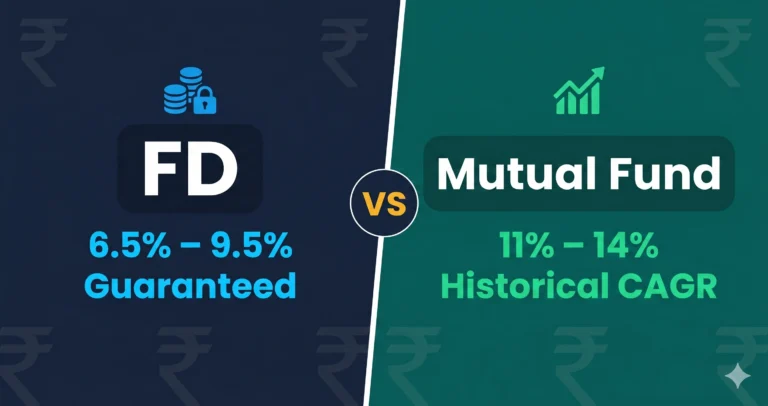
| Long-Term Return Potential | 11%–14% CAGR (Historical Averages) | 6.5%–9.5% (Contractually Guaranteed) | 11%–15% CAGR (Historical Averages) |
| Market Timing Requirements | ❌ No Timing Needed | ❌ No Timing Needed | ✅ High Strategic Timing Needs |
| Capital Protection Status | Market-Linked Risk Profiles | Fully Insured up to ₹5 Lakh via DICGC | Market-Linked Risk Profiles |
| Liquidity Configuration | High (Settles in 1-3 Days) | Restricted (Premature Penalties Apply) | High (Settles in 1-3 Days) |
| Tax Efficiency (Highest Slab) | 12.5% LTCG on gains above ₹1.25L threshold | Taxed annually at your full slab rate | 12.5% LTCG after a 12-month holding period |
For a detailed analysis of how systematic pathways perform relative to lump-sum allocations across historical market cycles, explore our comprehensive research analysis: SIP vs Lumpsum Investment: Which Strategy Works Better in India?
How to Initiate a Systematic Investment Plan in India
- Complete Your Centralized Digital KYC Validation Under SEBI regulations, completing Know Your Customer (KYC) compliance is a mandatory step for all mutual fund investments in India. To set up your profile, navigate to a verified digital onboarding intermediary and complete your verification using your PAN card and Aadhaar documentation: CAMS Official KYC Portal. This verification process takes only a few minutes and remains valid across all mutual fund houses in India.
- Select Your Preferred Investment Platform You can route your transactions directly through your preferred certified direct mutual fund dashboard or utility framework. Opting for direct mutual fund plans ensures your capital completely bypasses traditional distributor commissions, keeping your portfolio’s underlying expense ratio as low as possible.
- Select an Appropriate Asset Category For beginners, starting with a diversified Nifty 50 large-cap index fund or a broad flexi-cap scheme is often recommended. These categories offer built-in diversification across top-tier businesses and feature low operational expense ratios, making them an excellent core foundation for your portfolio.
- Schedule Your Monthly Transfer Date A practical rule of thumb is to schedule your automated investment date roughly 3 to 5 days after your monthly salary credit window. This setup ensures that your investment capital is automatically prioritized and deployed before other discretionary spending can occur.
Taxation Framework Governing Domestic Equity Allocations
When planning your portfolio, it is important to remember that each monthly systematic contribution is treated as an independent investment with its own distinct purchase date. This timeline dictates how capital gains tax is calculated when you eventually redeem your assets:
| Capital Gain Category | Asset Holding Window | Statutory Tax Rate | Exemption Threshold Limits |
|---|---|---|---|
| STCG (Short-Term Capital Gains) | Less than 12 Months | 20% Flat Rate | Fully Taxable from Rupee One |
| LTCG (Long-Term Capital Gains) | Exceeding 12 Months | 12.5% Flat Rate | ₹1.25 Lakh Profit per Year Exempt |
| Debt Fund Short-Term Gains | Less than 24 Months | Taxed at your marginal slab rate | Added directly to your annual gross income |
| Debt Fund Long-Term Gains | Exceeding 24 Months | Taxed at your marginal slab rate | Processed at standard slab rates without indexation |
Regulatory Compliance Source: Income Tax Department, Government of India Official Archive.
Because each monthly installment carries its own 12-month timeline, redeeming a multi-year portfolio means your oldest units will typically qualify for the lower long-term capital gains rate, while your most recent contributions will be processed under short-term rules. Most modern investment dashboards handle these calculations automatically using a First-In, First-Out (FIFO) method, allowing you to download an updated tax report before filing your annual returns.
Run Your Exact Systematic Projections Instantly
Utilize our specialized, high-speed mathematical simulators to evaluate accurate compounding outcomes alongside tax adjustments.
Open FiiPay SIP Calculator Matrix → Compare Against Fixed Income →Frequently Asked Questions About SIP
Conclusion: Consistency Beats Market Timing
Building long-term wealth through an SIP relies on financial discipline rather than complex market timing. Automating your investments allows your capital to grow steadily over time, smoothing out short-term market volatility and helping you reach your financial milestones with confidence.
Setting up your portfolio is a straightforward process that takes only a few minutes. By maintaining a disciplined approach and steadily scaling your contributions alongside your income growth, you can harness the full power of long-term compounding to secure your financial future.