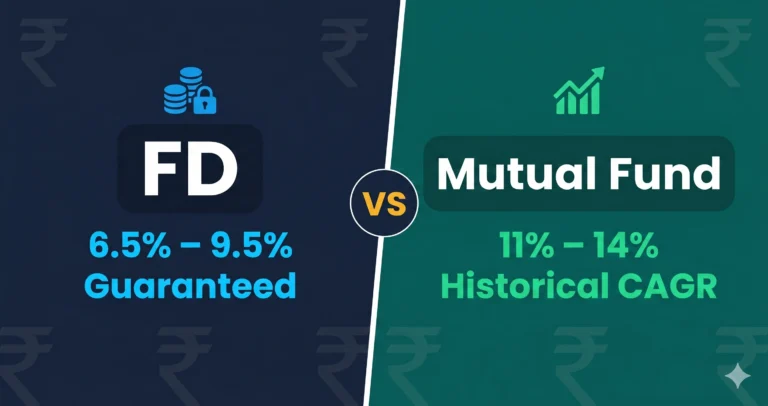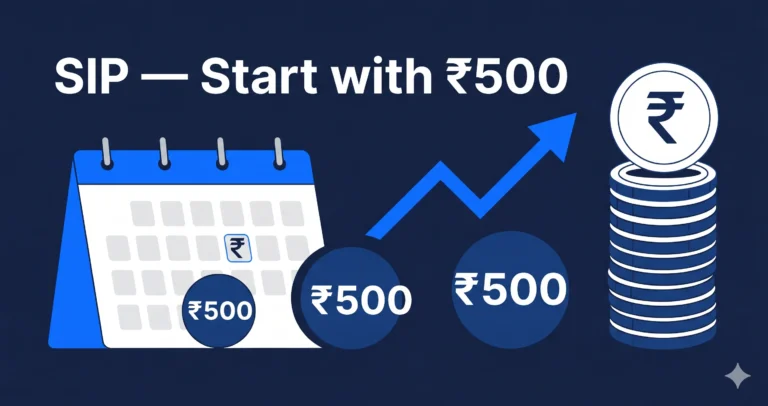

A SIP is simply an automated, modern version of a recurring deposit — except instead of your bank compounding your money at 6–7%, a well-chosen equity fund historically compounds it at 11–14% over the long run. If you have been delaying starting a SIP because the process seems complicated, the actual steps take 20 minutes. But in 2026, there is one specific thing that is silently blocking thousands of new investors before they place their first order — and nobody is warning them about it upfront.
Your KYC status with SEBI’s KRA system determines whether your SIP goes through or gets blocked on Day 1. Check which category you fall into before opening any app:
🔴 Check This First — Your KYC Status Determines Everything
KYC done via Aadhaar + OTP. PAN and Aadhaar are linked. Email and mobile are verified with the KRA.
✅ Yes — you can start a new SIP with any mutual fund (AMC) in India immediately. No restrictions.
KYC done via non-Aadhaar document (Passport, Voter ID). Email or mobile not verified via Aadhaar OTP.
⚠️ Only in AMCs where you already have a folio. To start a new SIP with a new fund house, you must upgrade your KYC first.
PAN and Aadhaar are de-linked, or your email/mobile verification failed or was flagged by the KRA.
🚫 No — all transactions including new SIPs and existing SIP redemptions are frozen until resolved.
Check your exact KYC status right now using your PAN — takes under 60 seconds.
Check on CVL KRA Portal →The 2026 SEBI KYC Trap: Why Beginner SIPs Are Being Blocked
In 2022, SEBI tightened the KYC Registration Agency (KRA) framework to curb identity fraud in mutual fund investments. The change that catches most beginners: doing KYC once on one platform no longer automatically gives you “Validated” status everywhere. The method of your original KYC determines your access level across all AMCs.
If you did your KYC years ago using a physical form or a scanned Voter ID — that gave you “KYC Registered” status. It was fine then. In 2026, it means you cannot open a new folio with a new fund house. You will get an error at checkout saying “KYC not valid for new investments” and have no idea why.
How to Fix KYC and Upgrade to “Validated” Status
The upgrade is straightforward but requires specific documents:
- Your Aadhaar must be linked to your mobile number — the OTP during KYC goes to the mobile registered with UIDAI. If your Aadhaar is not mobile-linked, visit your nearest Aadhaar enrolment centre first.
- Your PAN must be linked to Aadhaar — verify at the Income Tax portal. Unlinked PAN + Aadhaar = automatic “KYC On Hold” status.
- Re-do KYC using Aadhaar-based eKYC — available on all major platforms (Groww, Zerodha Coin, Kuvera, MFCentral). The process takes 5–7 minutes and updates your KRA status to “Validated” within 1–3 working days.
Once your KYC is Validated, use MFCentral — the official AMFI and CAMS portal — to see all your mutual fund folios across all AMCs in one dashboard. No login needed beyond your PAN and registered mobile. This is the only authoritative official aggregator in India for fund tracking.
Step 1: Gather Your Documents and Clear Your KYC
📋 Step 1 of 4Three things are mandatory before any SIP can start. Get these ready before opening any app:
- Aadhaar card — must be linked to an active mobile number. The eKYC process sends an OTP to your Aadhaar-registered mobile. Without this, you cannot achieve “KYC Validated” status.
- PAN card — mandatory for all mutual fund investments per SEBI rules. PAN must be linked to Aadhaar on the Income Tax portal. If not linked, fix this before starting.
- Bank account details — account number, IFSC code, and a bank account in your name for both SIP debits (NACH mandate) and redemption credits. If you need your IFSC code, make sure you access reliable validation vectors.
Once documents are ready, check your KYC status at CVL KRA. If you are “Validated” — proceed to Step 2. If “Registered” or “On Hold” — fix the KYC first using Aadhaar-based eKYC on any major platform before doing anything else.
Step 2: Choose Your Platform and Avoid the Regular Plan Trap
📱 Step 2 of 4This is the single decision that can cost you ₹15–25 lakh over 20 years — and most bank managers will never tell you about it.
- No intermediary, no commission
- Expense ratio: 0.05%–0.60% (equity)
- Available on: Groww, Zerodha Coin, Kuvera, Angel One, MFCentral
- Same fund, same NAV source — just more of it goes to your corpus
- Always choose “Direct” + “Growth” option
- Includes 0.75%–1.50% annual distribution commission paid to broker or bank
- Sold by bank relationship managers, local agents, most traditional brokers
- The commission is deducted invisibly from your returns every year
- On ₹10,000/month SIP for 20 years: costs ₹15–22 lakh more in lost corpus vs Direct
- Never the right choice for a self-directed investor
Use an aggregator platform to launch your investments safely. Platforms like Angel One provide an entirely digital, zero-commission environment for starting Direct mutual fund pipelines while maintaining a clean, comprehensive analysis panel for your equities.

Get Angel One Demat Account for FREE and Enjoy Exclusive Benefits
Alternatively, you can invest directly on the fund house’s own website (e.g., SBI Mutual Fund, HDFC Mutual Fund) — these are always Direct by default but require managing multiple log-ins across different portals.
When you tell your bank relationship manager you want to “invest in mutual funds,” they will typically direct you to their bank’s own AMC or to a tied-up distributor — almost always a Regular plan. This is not illegal, but it is not in your best interest. Politely decline and use an independent Direct plan platform instead.
Step 3: Which Mutual Fund Category Should You Pick?
🏦 Step 3 of 4Don’t overthink fund selection as a beginner. Three buckets cover 95% of retail investor needs:
Calculate What Your SIP Will Grow To
Enter your monthly amount and see the year-wise corpus breakdown before committing
Open SIP Calculator → Compare vs FD →Step 4: Setting Up the NACH e-Mandate (Auto-Pay)
⚡ Step 4 of 4Once your fund and amount are selected, the final step is authorising the automatic monthly debit from your bank account. This is called the NACH mandate (National Automated Clearing House) — an RBI-regulated system that lets the fund house debit a fixed amount on your chosen SIP date every month, without you having to do anything manually.
Think of it exactly like the auto-debit your bank does for your electricity bill or loan repayments — except this one builds your wealth instead of clear liabilities.
- Enter Bank Details
Provide your bank account number, IFSC code, and account type (Savings/Current). Your IFSC code identifies your exact bank branch for the mandate routing.
- Approve via Net Banking, Debit Card, or UPI Autopay
Net Banking approval: log into your bank’s netbanking and approve the mandate request — this appears within 2–3 business days. Debit card approval: instant on most platforms. UPI Autopay: fastest option — activated in minutes using your preferred UPI provider.
- Wait for Mandate Registration
NACH registration takes 7–15 days depending on your bank. However, in 2026, the RBI’s specialized framework for automatic investment clearances allows UPI Autopay mechanisms up to ₹1 Lakh per transaction to activate almost instantly.
- Your SIP Runs Automatically From Here
On your chosen SIP date every month, the amount is auto-debited and mutual fund units are allotted at that day’s closing NAV. You receive a transaction confirmation by email and SMS. No action needed from you every month.
If your platform supports UPI Autopay, use it over traditional paper NACH mandates. Activation is near-instant, there are no structural banking delays, and you can pause or cancel the auto-debit directly from your UPI app interface without having to issue formal letters to your branch manager.
Frequently Asked Questions
Start Today — The Process Is 20 Minutes
Starting a SIP in 2026 has exactly four steps: check your KYC status on CVL KRA, choose a Direct Growth plan on a platform like Groww, Zerodha Coin, or Angel One, pick a Nifty 50 index fund as your first SIP, and set up UPI autopay for the monthly debit. That is it. The process that sounds complicated in financial blogs takes 20 minutes in practice.
The only thing that genuinely trips up beginners in 2026 is the KYC status issue. Check it first, fix it if needed, and the rest flows in one sitting.
➡️ SIP Calculator — See your corpus projection before starting
➡️ FD Calculator — Compare SIP vs FD returns over same tenure
➡️ RD Calculator — Map systematically expanding savings timelines