

📌 Quick Verdict — June 2026
PPF, ELSS, and NPS — What Are They?
All three qualify for deduction under Section 80C of the Income Tax Act, up to ₹1.5 lakh per financial year (old tax regime only). But they are fundamentally different instruments with different return profiles, risk levels, liquidity, and tax treatment at maturity. Choosing the wrong one for your situation costs you real money — not just at tax time but over the entire holding period.
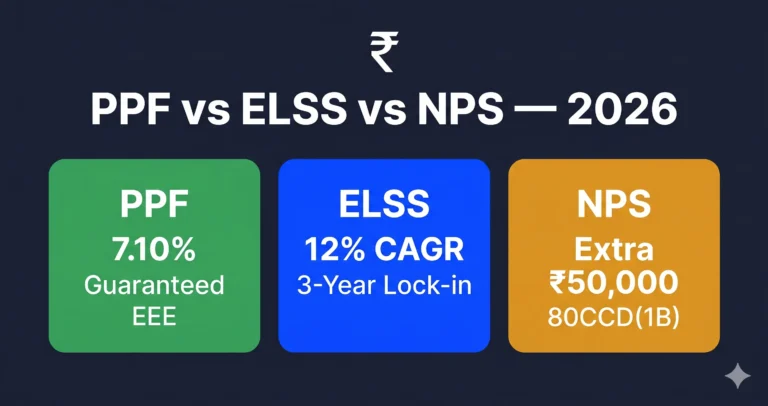
PPF (Public Provident Fund) is a government-backed small savings scheme offering 7.10% per annum for Q1 2026-27, fully tax-free at all stages. Rate set quarterly by the Ministry of Finance.
ELSS (Equity Linked Savings Scheme) is a mutual fund that invests primarily in equities. It has the shortest lock-in among all 80C instruments — just 3 years per instalment. Returns are market-linked and historically 11–14% CAGR over long periods per AMFI category performance data.
NPS (National Pension System) is a retirement-focused instrument regulated by PFRDA. It offers equity, corporate bond, and government securities allocation. The additional ₹50,000 deduction under Section 80CCD(1B) — over and above the ₹1.5 lakh 80C ceiling — is its unique tax advantage.
Complete Comparison — PPF vs ELSS vs NPS (June 2026)
| Parameter | PPF | ELSS | NPS (Tier 1) |
|---|---|---|---|
| Returns (June 2026) | 7.10% p.a. (guaranteed) | 11–14% CAGR (historical, not guaranteed) | 9–12% CAGR (equity option, historical) |
| Tax Treatment | EEE — Fully Tax Free | EEE* — LTCG 12.5% above ₹1.25L | Partial — 60% tax-free, 40% annuity taxed |
| Lock-in Period | 15 years (partial withdrawal after Year 7) | 3 years per instalment | Until age 60 (exit before 60 allowed with restrictions) |
| 80C Deduction Limit | ₹1.5 lakh/year | ₹1.5 lakh/year | ₹1.5L (80C) + ₹50,000 extra (80CCD(1B)) |
| Risk Level | Zero (sovereign guaranteed) | High (100% equity) | Moderate (asset allocation model) |
| Liquidity | Partial from Year 7. Full at 15 years. | Full after 3-year lock-in per instalment | Very restricted until age 60 |
| Minimum Investment | ₹500/year | ₹500/month (SIP) | ₹1,000/year (Tier 1) |
| Maximum Investment | ₹1.5 lakh/year | No upper limit (80C capped at ₹1.5L) | No upper limit (deduction capped) |
| Best Suited For | Risk-averse, all tax slabs | 20–30% slab, 7+ year horizon | Retirement savings, salaried with HRA |
| * ELSS LTCG: 12.5% on gains above ₹1.25 lakh per year per Finance Act 2024. PPF rate: 7.10% Q1 2026-27. NPS returns: historical CAGR on equity option. Not investment advice. | |||
Sources: National Savings Institute (PPF rate); PFRDA (NPS); AMFI (ELSS returns); Income Tax Department (80C rules). June 2026.
Old vs New Tax Regime: Which Saves You More?
Don’t finalize your tax declaration based on guesswork. Enter your salary, 80C, and home loan deductions into our tool to instantly see the exact mathematical difference between both regimes.
Compare My Taxes Now →The Tax Treatment — EEE, EET, and What It Actually Means
The most misunderstood aspect of these three instruments is the EEE vs EEE* distinction at maturity. Here is what each letter means and where each instrument actually stands:
E-E-E means: Exempt at investment (80C deduction) → Exempt during growth (no annual tax on returns) → Exempt at maturity (no tax on withdrawal). PPF is genuinely EEE — you owe zero tax at any stage.
ELSS is almost EEE but not quite. The investment and growth are tax-free. At redemption, gains above ₹1.25 lakh per year attract 12.5% LTCG. For small ELSS investors (corpus under ₹15–20 lakh), the annual ₹1.25 lakh exemption may cover most or all of their gains — making ELSS effectively EEE in practice. For large investors, the LTCG becomes meaningful.
NPS is EEE-partial. At maturity: 60% of the corpus can be withdrawn tax-free. The remaining 40% must be used to purchase an annuity — and the annuity income is taxed as per your income slab every year in retirement. This mandatory annuity is the key limitation of NPS for many investors.
The mandatory 40% annuity in NPS is often glossed over in tax-saving guides. If your NPS corpus at retirement is ₹1 crore, ₹40 lakh must go into an annuity at approximately 5–6% annual payout. That generates ₹2–2.4 lakh/year in annuity income — which is fully taxable as salary income. Factor this into your retirement planning, especially if you expect to be in a meaningful tax slab even after retirement.
Real Returns Over 15 Years — Numbers That Matter
Assuming a ₹1.5 lakh annual investment (made at the start of every year) for 15 years:
| Instrument | Total Invested | Estimated Corpus (15 Yrs) | Approximate Returns | Tax at Withdrawal (30% slab) | Post-Tax Corpus |
|---|---|---|---|---|---|
| PPF (7.10% p.a.) | ₹22,50,000 | ₹40,68,000 | ₹18,18,000 | ₹0 (EEE) | ₹40,68,000 |
| ELSS (12% CAGR) | ₹22,50,000 | ₹62,66,000 | ₹40,16,000 | ~₹4,86,000 (12.5% LTCG net of ₹1.25L/yr exemption) | ~₹57,80,000 |
| NPS (10% CAGR) | ₹22,50,000 | ₹52,42,000 | ₹29,92,000 | 40% → annuity (taxed annually as income) | ~₹31,45,000 tax-free + annuity income |
| * Illustrative mathematics — assumes PPF at 7.10% constant, ELSS at 12% constant CAGR, NPS equity at 10% constant CAGR for annual investments made at the start of the year. Actual returns will vary. Tax calculations are estimates. Not investment advice. | |||||
The gap between ELSS and PPF post-tax is approximately ₹17 lakh over 15 years on the same ₹1.5 lakh annual investment. This is the equity premium — the reward for accepting market volatility over a long horizon. Over shorter periods (3–5 years), this premium can disappear or go negative in a bad market cycle.
Who Should Choose Which — Practical Decision Guide
- You are in the 5% tax slab and the 80C deduction gives you ₹7,500 savings — equity risk isn’t worth it
- Your goal is 15+ years (child’s marriage, retirement lump sum)
- You need guaranteed, predictable returns to sleep well
- You are a government employee or pensioner who already has equity exposure via ELSS elsewhere
- You want sovereign-guaranteed savings with zero paperwork after account opening
- You are in the 20% or 30% tax bracket — the ₹30,000–₹46,800 annual tax saving is meaningful
- Your goal is 7+ years and you have existing emergency fund safety net
- You want the lowest lock-in among 80C instruments (3 years per SIP instalment)
- You are already investing in PPF and want your 80C investment to beat inflation
- You understand that equity can fall 30–40% temporarily and you won’t panic-redeem
- You have already maxed ₹1.5 lakh under 80C and want to save an additional ₹50,000 tax via 80CCD(1B)
- You are building a dedicated retirement corpus separate from other investments
- You are a salaried employee with employer NPS contribution (additional 10% of basic deductible under 80CCD(2))
- You are comfortable with the 40% mandatory annuity at maturity
- You want equity market participation with an automatic life-cycle asset allocation as you age
The Optimal Strategy: Combine All Three
Most financial advisors and the AMFI data both support a split allocation as the highest-value approach for investors in the 20–30% tax bracket:
PPF: ₹50,000/year — Your guaranteed, fully EEE anchor. Provides capital safety, partial withdrawal option from Year 7, and a stable non-market-linked 80C block.
ELSS SIP: ₹1,00,000/year (₹8,333/month) — Fills the remaining ₹1 lakh of your 80C limit with equity compounding potential. 3-year rolling liquidity.
NPS (80CCD(1B)): ₹50,000/year — Beyond the ₹1.5 lakh 80C ceiling. At 30% slab, saves an additional ₹15,000 in tax annually. Builds a separate retirement corpus.
Total annual tax deduction: ₹2 lakh. Tax saved at 30% slab: ₹62,400 (including cess).
If you have opted for the New Tax Regime, Section 80C deductions (PPF, ELSS, NPS 80C portion) do not apply. Only employer NPS contribution under 80CCD(2) remains deductible under the new regime. If you are on the new regime, switching to PPF or ELSS purely for 80C benefit has zero tax advantage. Evaluate them purely on return merit. Consult a CA on whether switching to the old regime is worthwhile based on your total income and deductions.
Calculate Your SIP and Lumpsum Returns
Model your ELSS SIP growth vs PPF using our free calculators
SIP Calculator → FD vs ELSS Numbers →Frequently Asked Questions
Conclusion
PPF, ELSS, and NPS solve three different financial problems. PPF solves the capital safety problem. ELSS solves the inflation-beating return problem within a tax wrapper. NPS solves the retirement savings and additional deduction problem. Treating them as competitors and picking one means leaving at least one of these problems unsolved.
For most investors in the 20–30% bracket with a stable income: start with an ELSS SIP to fill most of the ₹1.5 lakh 80C limit, add PPF for the guaranteed anchor, and open an NPS Tier 1 account for the extra ₹50,000 deduction. Review allocation once a year — not after every market swing.
➡️ SIP Calculator — Model your ELSS SIP corpus over 10, 15, and 20 years
➡️ What is SIP? — Complete beginner’s guide to starting an ELSS or equity SIP
➡️ SIP vs Lumpsum — Which strategy works better for ELSS investment?
➡️ FD vs Mutual Fund — How ELSS compares to FD for the same tenure
