

FD vs Mutual Fund: The Ultimate Showdown for Your Investment Needs
📌 Short Answer
FD wins for goals within 3 years, capital protection needs, and investors who cannot tolerate any short-term loss. Mutual funds (equity SIP) win for goals beyond 7 years, inflation-beating returns, and investors in the 20–30% tax bracket where the post-tax return gap is substantial. For most households, the right answer is both — FD for safety, SIP for growth.
The Core Difference in One Paragraph
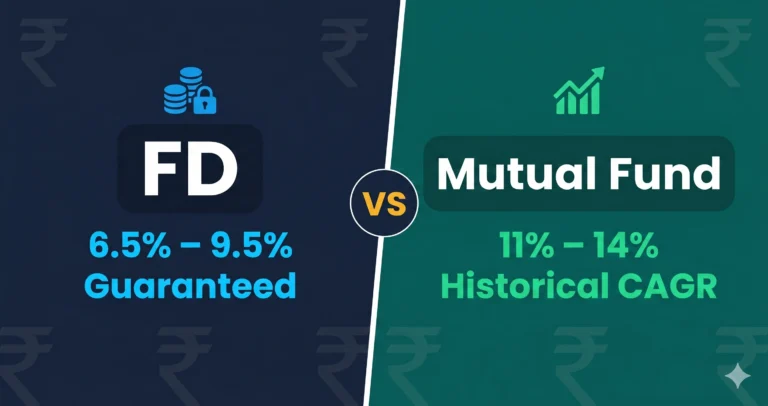
A Fixed Deposit locks your money with a bank for a set period at a guaranteed rate — currently 6.50%–9.50% depending on the bank and tenure in India as of June 2026. Your principal is safe, the return is predictable, and DICGC insures deposits up to ₹5 lakh per bank. A Mutual Fund pools your money with other investors and deploys it into stocks, bonds, or both. The return is market-linked — historically 11–14% CAGR for equity funds over 10+ year periods per AMFI data — but not guaranteed, and the value can fall in the short term.
The fundamental tradeoff is certainty vs. growth potential. Which matters more depends entirely on when you need the money and how your income is taxed.
FD vs Mutual Fund — Complete Comparison (June 2026)
| Parameter | Fixed Deposit (Bank) | Equity Mutual Fund (SIP) | Debt Mutual Fund |
|---|---|---|---|
| Returns (June 2026) | 6.50%–9.50% p.a. (guaranteed) | 11–14% CAGR historically (not guaranteed) | 7.00%–8.50% (indicative) |
| Capital Protection | ✅ Full (DICGC ₹5L) | ❌ Market risk | ⚠️ Low risk, not guaranteed |
| Returns Guaranteed? | ✅ Yes — rate locked | ❌ No | ❌ No |
| Tax (30% slab) | 30% on all interest | 12.5% LTCG (gains above ₹1.25L) | Slab rate (Finance Act 2024 updates) |
| Post-Tax Return (30% slab, 7.25% FD) | ~5.07% effective | ~10.5%+ (12% gross, 12.5% LTCG) | ~5.5–6.0% |
| Liquidity | ⚠️ Penalty if broken early | ✅ Redeem in 1–3 days | ✅ Redeem in 1–2 days |
| Lock-in | Until maturity (penalty for exit) | None (except ELSS: 3 years) | None |
| Minimum Investment | ₹1,000 (most banks) | ₹500/month (SIP) | ₹500/month (SIP) |
| Inflation Beating (5–6%)? | ⚠️ Barely (post-tax) | ✅ Historically yes | ⚠️ Marginally |
| Best Horizon | 1–5 years | 7+ years | 2–4 years |
Sources: AMFI Industry Data; Income Tax Department capital gains rules; Bank official websites (June 2026).
The Tax Difference Nobody Talks About Clearly
The biggest factor most investors ignore when comparing FD and mutual funds is the tax structure — not the headline return. Here is the real-money difference on ₹5 lakh invested over 5 years for a 30% slab investor:
| Scenario (₹5L for 5 Years, 30% slab) | FD @ 7.25% | Equity MF @ 12% CAGR |
|---|---|---|
| Gross Maturity | ₹7,14,448 | ₹8,81,170 |
| Total Gain | ₹2,14,448 | ₹3,81,170 |
| Tax Payable | ₹64,334 (30% of total interest) | ₹31,896 (12.5% on gains above ₹1.25L) |
| Post-Tax Take-Home | ₹6,50,114 | ₹8,49,274 |
| Difference | Mutual Fund gives ₹1,99,160 more post-tax | |
Even for a cumulative FD (where interest is paid at maturity), the interest accrued each year is taxable in that year’s ITR. Many investors assume tax is deferred to maturity — it is not. You owe tax on FD interest every year it accrues, regardless of when you receive it. Equity mutual fund gains are only taxable when you actually redeem.
When FD Wins vs When Mutual Fund Wins
🏦 Choose FD When:
You need money within 1–3 years and cannot risk a 20% short-term dip. Your income is in the 5% tax slab where the FD tax burden is minimal. You are building an emergency fund that must be accessible without market dependency. You are a retiree needing predictable quarterly interest payouts.
✅ FD Wins Here📈 Choose Mutual Fund When:
Your goal is 7+ years away (child’s education, retirement). You are in the 20–30% tax bracket where the LTCG advantage is significant. Your FD interest is barely beating inflation after tax. You want to invest monthly from salary — SIP automates this perfectly.
✅ Mutual Fund Wins Here🛡️ Large Amounts You Can’t Risk
Proceeds from property sale, inheritance, or retirement gratuity that you cannot afford to see temporarily decline. FD (or split across multiple banks within DICGC limits) preserves every rupee regardless of market conditions.
✅ FD Wins Here📊 When Inflation is Your Enemy
With India’s average inflation at 5–6%, a 7.25% FD at 30% tax slab yields ~5.07% post-tax — barely covering inflation in real terms. Over 15+ years, this erodes purchasing power. Equity funds have historically delivered 7–9% real returns above inflation.
✅ Mutual Fund Wins HereThe Smart Approach: Use Both
The FD vs mutual fund debate is largely a false choice. Most financially healthy households should hold both, allocated by goal timeline:
- Emergency fund (3–6 months expenses): Sweep-in FD at SBI, HDFC, or any major bank. Instantly accessible, earns 6.5–7% while sitting idle. Never put this in equity.
- Goals within 2–3 years (vacation, car down payment, home renovation): FD or debt mutual fund. Certainty matters more than maximum return here.
- Goals 5–7 years away (home down payment): Balanced hybrid funds or conservative flexi-cap SIP. More growth potential with moderate risk.
- Goals 10+ years away (retirement, children’s college): Equity SIP in large-cap index fund or flexi-cap fund. Maximum long-term compounding. FD is the wrong tool here.
Keep 20% of your savings in FD (emergency fund + near-term goals). Invest 80% via SIP for medium and long-term goals. Adjust the ratio as you approach retirement — gradually shift from equity to FD/debt as your time horizon shortens.
Calculate Your Own FD vs SIP Numbers
Enter your exact principal, rate, and tenure to compare actual maturity amounts
FD Calculator → SIP Calculator →Frequently Asked Questions
Verdict
FD and mutual funds are not competitors — they are complementary tools for different financial jobs. Use FD where certainty matters: emergency funds, short-term goals, large amounts you cannot afford to see dip temporarily. Use SIP in equity mutual funds where time is your asset: retirement, children’s education, any goal 7+ years away where the compounding and tax efficiency advantages compound significantly.
The single biggest mistake Indian investors make is leaving 10-year money in FDs because they feel “safe” — and discovering at retirement that their corpus barely kept pace with inflation. Start your SIP today, protect your emergency fund in FD, and let both tools do what they are designed for.
➡️ Best FD Rates in India June 2026 — For your FD allocation
➡️ SIP vs Lumpsum: Which strategy works better for mutual fund investing?
➡️ FD Calculator — Maturity, post-tax return, and premature withdrawal
➡️ SIP Calculator — Corpus projection with year-wise breakdown