
Best AePS Service Provider in India 2026: Honest Comparison After 4 Years of Cash-Out Counter Operations
Complete top 10 best AEPS Company List (Verified 2026)
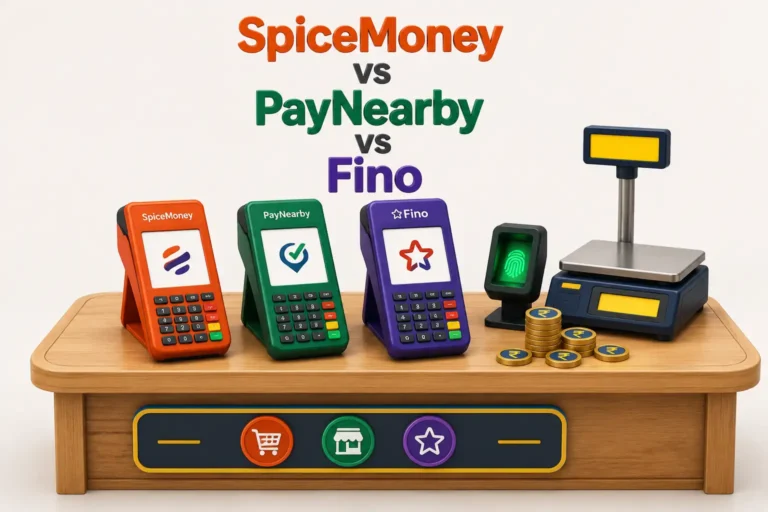
Before we dive into the deep reviews and commission charts, here is the direct answer. If you are a rural merchant looking for the best AEPS ID to start your BC business, these are the authorized and actively operating portals in the Indian market right now:
- Spice Money
- PayNearby
- Fino Payment Bank
- CSC (DigiPay)
- Airtel Payments Bank
- Bankit
- RapiPay
- Eko India
- RNFI (Relipay)
- Aeps India / Noble Web
Warning from my counter experience: Do not buy IDs from unknown white-label apps running on WhatsApp forwards. Stick to the all AEPS company list above to ensure your settlements don’t get stuck.
What is AePS and Why It Still Matters for Merchants in 2026
🧮 Stop Losing AEPS Commission to Hidden Charges!
Think you are earning ₹10 per withdrawal? After ‘Move-to-Bank’ settlement fees and shop expenses, your real profit is much lower. Find out your true take-home earnings now.
Calculate My Net Profit →The Aadhaar-enabled Payment System (AePS) — built and governed by the National Payments Corporation of India (NPCI) — allows any Indian bank account holder to withdraw cash, check balance, or generate a mini statement simply by placing their finger on a biometric scanner. No debit card. No PIN. No smartphone. Just their Aadhaar number and their fingerprint.
For the 200+ million Indians who are formally banked but functionally underserved — daily-wage labourers who receive government DBT transfers, MNREGA beneficiaries in villages without ATMs, migrant workers receiving EPFO settlements — AePS is not a convenience. It is their only banking access point. As a merchant deploying an AePS kiosk, you are not selling a product. You are providing essential financial infrastructure.
The business case is equally compelling. A well-run AePS counter in a rural or semi-urban market doing 15–25 transactions per day generates a meaningful supplemental income stream, particularly when expanded into the full multi-service ecosystem described later in this article.
The competitive intensity at individual merchant level has increased — there are more AePS kiosks per square kilometre in dense rural markets than 3 years ago. The merchants who are growing their income are those who have expanded beyond cash-out into the full 7-service digital banking kiosk model. The ones struggling are those operating single-service cash-out points with L0 devices that now generate transaction failures. This article is specifically written to help you get into the first group.
Best AePS Service Providers in India 2026 — Quick Comparison
After evaluating 8 major platforms across commission structure, server uptime, settlement speed, support quality, and multi-service availability, here is the consolidated comparison:
| Provider | Our Rating | Best For | Settlement | Commission (per withdrawal) | L1 Support | DMT | BBPS | PAN Services | IRCTC |
|---|---|---|---|---|---|---|---|---|---|
| Ezeepay ⭐ Top Pick | ★★★★★ | UP, Bihar, MP, Rajasthan rural markets | T+0 | ₹8–₹12 | ✅ | ✅ | ✅ | ✅ | ✅ |
| Spice Money ⭐ Top Pick | ★★★★★ | Multi-service rural BC network | T+0 | ₹7–₹11 | ✅ | ✅ | ✅ | ✅ | ✅ |
| PayNearby | ★★★★½ | Urban semi-urban, high-volume agents | T+0 | ₹6–₹10 | ✅ | ✅ | ✅ | ✅ | Partial |
| FingPay (Fino) | ★★★★ | Compliance-first operators | T+1 | ₹6–₹9 | ✅ | ✅ | ✅ | Via partner | ❌ |
| FINO Payments Bank | ★★★★ | Direct bank BC relationship | T+1 | ₹5–₹8 | ✅ | Limited | ✅ | ❌ | ❌ |
| Airtel Payments Bank | ★★★½ | Airtel telecom-linked merchants | T+1 | ₹5–₹8 | ✅ | Limited | ✅ | ❌ | ❌ |
| DigiPay (IPPB) | ★★★ | Tier 4/5 post office-linked operators | T+1 to T+2 | ₹4–₹7 | ✅ | Basic | Basic | ❌ | ❌ |
| Muthoot FinCorp | ★★★ | South India gold-loan combined points | T+1 | ₹5–₹8 | ✅ | Limited | Limited | ❌ | ❌ |
| * Commission rates are indicative per-transaction ranges as of mid-2026. Actual rates depend on volume slabs and individual BC agreements. T+0 = same-day settlement. Verify current rates directly with the provider. This comparison is based on independent operational experience and does not constitute endorsement. | |||||||||
Source: Direct operational experience, provider documentation, and NPCI AePS framework guidelines (npci.org.in). Rates compiled july 2026.
Detailed Provider Reviews — From the Ground Up
🥇 Ezeepay
Best Overall — Rural India Benchmark
- Consistently the most stable server in UP, Bihar, and Rajasthan markets — we have run this platform through harvest season transaction spikes without downtime
- Commission slabs are among the most competitive — ₹10–₹12 per withdrawal on higher daily volume tiers
- Mini-statement separately incentivised (₹3–₹5 per request)
- DMT integrated with IMPS rails — typically settles within 2–5 minutes
- Dedicated district-level support agents in major rural markets
- IRCTC rail booking and BBPS fully integrated in single dashboard
🥇 Spice Money
Best Multi-Service Deployment
- Spice Money Adhikari app is one of the most feature-complete merchant interfaces in the Indian BC market
- Insurance product cross-sell (PM Suraksha Bima, PM Jeevan Jyoti) adds commission income without extra hardware
- BBPS utility bill collection covers 200+ billers including electricity, water, gas
- Volume-based monthly bonuses: ₹1,000 at 300 txn/month, ₹2,500+ at 700 txn/month (indicative)
- PAN card services (NSDL/UTIITSL) natively integrated
- One of the largest rural merchant networks in India — strong brand recognition with end customers
🥈 PayNearby
Best for High-Volume Urban Agents
- Largest independent merchant network by count — 3 million+ active Nanodhan agents
- Strong in Maharashtra, Karnataka, Gujarat, and Tamil Nadu
- StoreKing retail platform integration for product distribution commission
- API quality among the best — very few transaction timeouts in our experience
- Robust dashboard analytics — daily, weekly transaction reports by service type
🥈 FingPay (Fino)
Best for Compliance-First Operators
- Full RBI-supervised Business Correspondent model — strongest compliance framework
- Fino Payments Bank integration allows operators to also open customer savings accounts
- Strong grievance redressal mechanism — escalation to BC coordinator within 24 hours
- Best for operators in states with active regulatory oversight (Maharashtra, Delhi)
The L1 Biometric Hardware Mandate: Everything You Must Know
If there is one operational reality that will determine whether your AePS counter succeeds or fails in 2026, it is your biometric device. UIDAI’s device certification framework has fundamentally changed — and operators still running L0 devices are experiencing systematic transaction failures that no provider can fix on the software side.
L0 vs L1 vs Iris: The Full Hardware Landscape
- Capture fingerprint image and send to server for processing
- No on-device cryptographic signing — replay attacks possible
- Identity cloning vulnerability: captured biometric data can be replayed
- NPCI and UIDAI have phased out L0 device registration
- Existing L0 devices generating increasing transaction rejections
- On-chip cryptographic signing — private key never leaves the device
- Each capture generates a unique signed PID block — replay attacks impossible
- Tamper-evident hardware — physical breach triggers key destruction
- UIDAI RD (Registered Device) service app required for activation
- Cost: ₹1,800–₹2,500 depending on model and supplier
- NPCI transaction success rates: significantly higher than L0
- Scans the iris pattern — unaffected by worn, scarred, or oily fingerprints
- Critical for labourers, farmers, construction workers, elderly customers
- Significantly improves transaction success rate for failed finger scans
- UIDAI-certified L1 iris devices available
- Cost: ₹3,500–₹5,000
- Strongly recommended as backup at any counter with 10+ daily txns
The Technical Reality of L1 Cryptographic Signing
Understanding why L1 devices are mandatory helps you explain it to fellow merchants and avoid being sold a refurbished L0 device disguised as “updated.” Here is the essential technical explanation in plain language:
When a customer places their finger on an L0 device, the device captures the fingerprint image and sends it as raw data to the provider’s server. This raw data — the PID block — could theoretically be intercepted, stored, and replayed later to authorise a fraudulent transaction without the customer’s actual presence. This is the replay attack vulnerability that criminals exploited to defraud government benefit recipients.
An L1 device contains a certified cryptographic chip (a tamper-proof secure element). When a fingerprint is captured, the PID block is signed inside the chip using a private key that is permanently embedded at the factory and can never be extracted. The resulting signed PID block includes a timestamp and a unique transaction identifier. Even if someone intercepts this signed PID block, they cannot reuse it — the UIDAI server immediately rejects any duplicate signature. The private key physically never leaves the device.
We have personally encountered sellers in UP and Bihar who relabel refurbished MFS100 (L0) devices as “upgraded MFS110 L1.” A genuine L1 device will have an UIDAI certification sticker with a QR code verifiable at cert.uidai.gov.in. Additionally, when you register the device with your provider’s UIDAI RD service app, an L0 device will fail the device registration check. Always purchase from the manufacturer’s authorised dealer or directly from Mantra/Morpho’s official website.
Face Authentication: Why It Is Not Available for Cash-Out in 2026
Several merchants have asked us about face authentication — the ability to authenticate AePS transactions using a customer’s face instead of a fingerprint. The expectation comes from early UIDAI demonstrations of face-auth integration in micro-banking apps around 2022–2023.
The current reality is unambiguous: face authentication for AePS cash-out channels remains paused or heavily restricted by regulatory authorities as of mid-2026. UIDAI and RBI’s concerns centre on deepfake spoofing — in controlled tests, sophisticated AI-generated videos of registered beneficiaries were able to pass face-auth systems in a meaningful percentage of attempts. The multi-factor merchant guidelines that would make face-auth acceptable have not yet been finalised to a standard that satisfies regulators.
For your operations: do not wait for face-auth to deploy. Your solution for customers with unreadable fingerprints is the iris scanner (Mantra MIS100V2). Iris biometrics are significantly more resistant to deepfake spoofing because they require the physical presence of the living eye and cannot be replicated from a photograph or video.
Face recognition-based AePS cash-out remains paused/heavily restricted per UIDAI regulatory guidelines due to deepfake spoofing vulnerabilities. Do not rely on face-auth for your counter operations. Use L1 fingerprint devices as primary authentication and iris scanner (Mantra MIS100V2) as backup for customers with failed fingerprint reads. This is the operationally correct and regulatory-compliant setup for 2026.
AePS Commission Structure: What You Actually Earn
Commission transparency is one area where the AePS industry has historically been opaque. BC agreements often state ranges without specifying the conditions for each tier. Based on 4 years of actual payout records across Ezeepay and Spice Money, here is what commission structures look like in practice:
Ezeepay — Commission Structure (Indicative, july 2026)
Spice Money — Commission Structure (Indicative, july 2026)
A counter doing 20 AePS withdrawals per day (average ₹8 commission), 5 mini-statements, 10 balance enquiries, and 3 DMT transactions earns approximately: ₹160 (withdrawals) + ₹20 (mini-statements) + ₹20 (enquiries) + ₹30 (DMT) = ₹230/day. Monthly: ₹6,900 plus any volume bonus. With BBPS, recharges, and PAN card services added, ₹10,000–₹15,000/month gross commission from a single point is realistic for a 30-35 transaction/day counter in a medium-density rural market.
Converting Your Shop Into a Complete Digital Banking Kiosk
A single-service AePS counter is a missed opportunity. The infrastructure cost — biometric device, internet connection, smartphone or laptop — is fixed. Adding each additional service is pure incremental commission revenue on the same hardware. Here is the complete service map for a profitable rural digital banking kiosk:
A counter we operated in a Tier 3 market (UP) with all 9 services active generated approximately ₹18,000–₹22,000/month gross commission during peak season (October–March, aligned with agricultural payment cycles and festive remittances). The AePS withdrawal itself accounted for only 55–60% of total commission — IRCTC ticketing (15%) and DMT (20%) contributed the remaining revenue. The operational lesson: the device is a platform, not a product.
How to Choose the Right AePS Service Provider: A 5-Step Framework
- Match the provider to your geography Ezeepay and Spice Money have the strongest server infrastructure for Hindi Belt states (UP, Bihar, MP, Rajasthan, Chhattisgarh, Jharkhand). PayNearby is stronger in Maharashtra, Karnataka, Gujarat. FingPay has consistent quality across all geographies. Your neighbour merchants’ experience in your specific district is more reliable data than platform-level marketing claims.
- Verify the settlement cycle with your working capital T+0 (same-day) settlement means the money you pay out to customers arrives in your agent wallet the same evening. T+1 means you need to float one day’s transaction value. If you do 30 transactions averaging ₹3,000 payout each, T+1 requires ₹90,000 of working capital tied up versus zero float requirement with T+0. This is not a minor difference for most rural operators.
- Audit the multi-service suite before signing Before signing any BC agreement, map exactly which of the 9 services in the ecosystem table above are available and whether they require separate sub-registrations. Some providers list IRCTC or PAN services on their website but require separate approvals that take 30–60 days. Confirm availability and go-live timelines in writing.
- Verify L1 device compatibility before purchase Confirm your specific L1 device model (Mantra MFS110 L1 or Morpho 1300 E3 L1) is supported by the provider’s UIDAI RD service integration. Most major providers support both, but some platforms have had temporary compatibility issues after UIDAI firmware updates. Ask the provider’s technical support to confirm before purchasing the device.
- Run a 30-day pilot before full commitment Most providers allow you to operate on a trial basis before committing the full BC deposit. During this pilot, track: transaction success rate, settlement accuracy (every settlement should match your transaction ledger), support response time for failed transactions, and server downtime during 8 AM–12 PM and 4–8 PM (peak transaction windows). Evaluate on these metrics, not on the demo.
Frequently Asked Questions
Final Verdict: Building a Profitable AePS Counter in 2026
Four years of ground-level operations have taught us one consistent lesson: the AePS merchants who grow their income year over year are not the ones who found the highest per-transaction rate. They are the ones who built reliable operational infrastructure — an L1 device, an iris scanner backup, stable internet, and a multi-service dashboard — and then showed up every day for their customers.
The provider choice matters, but less than you think. Both Ezeepay and Spice Money are exceptional platforms. If you are in UP, Bihar, or MP, start with Ezeepay. If you want the most comprehensive multi-service dashboard from Day 1, start with Spice Money. Run both after the first 6 months and use your own settlement records to determine which performs better in your specific location.
On the hardware: do not compromise. Buy the Mantra MFS110 L1 or the Morpho Safran MSO 1300 E3 L1. Buy the Mantra MIS100V2 iris scanner. The combined cost of ₹5,500–₹7,500 for both devices is recovered in 30–45 days of normal operations and protects your entire counter income.